Research highlights

Olive oil sheds new light on universality in phase transitions

A simple drop of olive oil in a system of photons bouncing between two mirrors, has revealed universal aspects of phase transitions in physics. Researchers at AMOLF used an oil-filled optical cavity in which light undergoes phase transitions similar to those in boiling water. The system they studied has memory because the oil causes photons to interact with themselves. By varying the distance between the two mirrors and measuring the transmission of light through the cavity, they discovered a universal law describing phase transitions in systems with memory. These results are published on April 15th in Physical Review Letters.

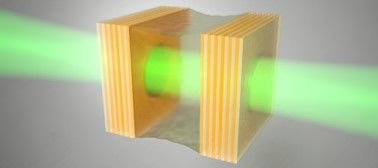
The experiments were performed with an optical cavity formed by two mirrors. Light sent through the cavity bounces between the mirrors before getting out where the transmission is measured. The researchers have filled this cavity with olive oil and changed the relative position of the mirrors at different speeds. Image by: Henk-Jan Boluijt (AMOLF)

The Interacting Photons research group at AMOLF studies non-linearity and noise in photonic systems. One of such systems is a cavity, formed by two mirrors facing each other at a close distance. Within the cavity, light bounces back and forth as it is reflected by the mirrors. Putting something inside such an optical cavity, changes the properties of the system. “We created a system with memory by placing a drop of olive oil inside the cavity”, says group leader Said Rodriguez. “The oil mediates effective photon-photon interactions, which we can see by measuring the transmission of laser light through this cavity.”

Scanning speed
Rodriguez and his PhD students Zou Geng and Kevin Peters analyzed the transmission while increasing and decreasing the distance between the two mirrors at different speeds. They found that the amount of light transmitted through the cavity depends on the direction of movement of the mirrors. “The transmission of light through the cavity is non-linear. At a certain distance between the mirrors, the amount of transmitted light depends on whether we are opening the cavity or closing it,” Rodriguez explains. “This behavior is called hysteresis. It is also observed in certain phase transitions, like in boiling water or magnetic materials.”

Universal
However, in the cavity with olive oil, hysteresis is not always present, the researchers observed when they increased the speed at which the cavity opens and closes. Rodriguez: “In faster scans, we saw the hysteresis vanish as a function of the scanning speed. This happens at a universal rate, independent of parameters like light intensity or the strength of the non-linearity. The equations that describe how light behaves in our oil-filled cavity are similar to those describing collections of atoms, superconductors and even high energy physics. Therefore, the universal behavior we discovered is likely to be observed in such systems as well.”

Coupling cavities
While it would be interesting to investigate the universal scaling behavior in other systems with memory, Rodriguez will keep his focus on oil-filled cavities. “Our system has a strong optical non-linearity at room temperature, which offers opportunities for potential applications”, he says. “We are currently investigating what happens when we couple two or more cavities. Because each system has memory, an array of cavities might eventually be useful as a computational tool, or maybe even in sensing applications.”

Reference
Z. Geng, K.J.H. Peters, A.A.P. Trichet, K. Malmir, R. Kolkowski, J.M. Smith and S.R.K. Rodriguez, Universal scaling in the dynamic hysteresis, and non-Markovian dynamics, of a tunable optical cavity, Physical Review Letters, 124, (2020)

Share article
What's happening

Most recent news items

All news items
Using light to control the composition of nanoparticles
Research highlights

Using light to control the composition of nanoparticles

Researchers from the Hybrid Nanosystems group at AMOLF have discovered how to use light to precisely control the composition of individual nanoparticles made of gold and copper. This ability to change the properties of nanoparticles could open new possibilities for catalysis, potentially contributing to more energy-efficient chemical processes. The researchers published their findings in the scientific journal Small.
Read news item
Research highlights

Designing materials that can compute through movement

AMOLF researchers from the Hypersmart Matter group have developed a new method for designing materials that use their own mechanical information to realize smart behavior, such as recognizing a specific word or performing calculations. Published in Nature Communications, the research brings scientists a step closer to creating materials that potentially need fewer or no electronic components, thus reducing energy consumption.
Read news item
People and recognition

Four PhD candidates close their AMOLF chapter

Four PhD students defended their thesis and are about to take the next steps in their career. Congratulations to Colin Meulblok (Mechanical Metamaterials), Francesca Scalerandi (Hybrid Nanosystems), Vashist Gangigude Ramesh (Interacting Photons), and Parisa Omidvar (Hypersmart Matter). We wish you all the best in your next steps!
Read news item
Joining forces to study perovskite interfaces
People and recognition

Joining forces to study perovskite interfaces

AMOLF group leaders Professor Wiebke Albrecht and Professor Bruno Ehrler have received an NWO ENW-M2 grant for their joint research project, The Dynamic Atomic Interface between Halide Perovskites and Metals. The insights gained will pave the way for sustainable, high-performance solar energy and information technology. Wiebke and Bruno will each hire a PhD student for this project. The grant amounts to €800.000.
Read news item
Stay informed

Get the latest research highlights, events, and news from our institute delivered to your inbox